

Table of Contents
- Why the Retro 90s Streetwear Aesthetic Is Dominating 2026
- Core Elements of the 90s Streetwear Aesthetic Guide
- Graphic Streetwear Brands and Bold Illustrated Tees
- How to Style Vintage T-Shirts for a Modern Look
- Building a Capsule Wardrobe with 90s Staples
- Layering Techniques for Retro-Inspired Outfits
- Conclusion
- Frequently Asked Questions
Last Updated: September 11, 2026
Why the Retro 90s Streetwear Aesthetic Is Dominating 2026
The retro 90s streetwear aesthetic guide 2026 starts with a simple observation: the oversized, washed-out looks that defined a decade of music videos and skate videos never really left. They just waited for the rest of fashion to catch up. At Dr. Stymie's Maker Products, LLC., we build apparel around exactly this energy, bold illustrated graphics, saturated color, and the kind of relaxed fit that makes getting dressed feel effortless instead of fussy.
The 90s streetwear comeback is not nostalgia for its own sake. It is a reaction against tight, high-gloss fast fashion. People want heavier fabrics, faded colors, and pieces that look like they have a history. Below, we break down the core elements of the look, the wardrobe staples worth owning, and how to style vintage pieces without looking like you raided a costume rack.
Core Elements of the 90s Streetwear Aesthetic Guide
The 90s streetwear aesthetic is a fashion style built on relaxed proportions, washed fabrics, and bold graphic imagery drawn from skate, hip-hop, and grunge culture. It favors oversized fit over tailoring, texture over shine, and self-expression over uniformity. Getting it right comes down to two pillars: silhouette and fabric.
Baggy Silhouettes and Retro Proportions
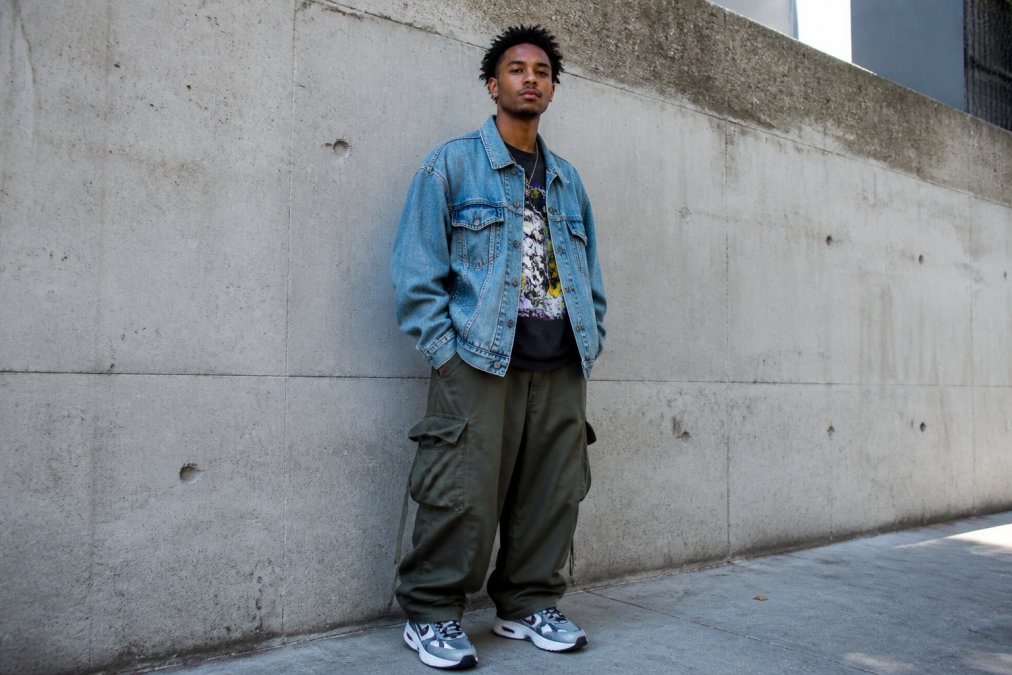
Baggy silhouettes are the backbone of the look. A common mistake is sizing up on everything at once, which reads as shapeless rather than intentional. Instead, balance volume: one oversized piece, one fitted piece. An oversized flannel over a fitted tee works. So do loose cargo pants with a closer-cut top.
Washed Denim, Flannel, and Textural Contrast
Textural contrast separates a good outfit from a flat one. Combine washed denim with flannel shirts, or a soft cotton tee with a heavier track jacket. Faded colors and heavier fabrics give the look its worn-in grit, and mixing two textures keeps an all-neutral palette from looking dull.
Graphic Streetwear Brands and Bold Illustrated Tees
Graphic streetwear brands live or die by their artwork, and the 90s set the template: thick outlines, exaggerated action, retro typography, and hidden details that reward a second look. When you shop, judge the print itself. Ask whether the illustration has a point of view or just fills space.
This is where Dr. Stymie's fits naturally. Our apparel draws on the bold illustrated T-shirt culture of the 1990s, with saturated colors, oversized cartoon graphics, and clever double meanings across Outdoors, Music, and Educator collections. Each design turns a hobby or profession into a wonderfully unnecessary field of study, which is exactly the irreverent streak that made 90s graphics memorable in the first place.
How to Style Vintage T-Shirts for a Modern Look
To style vintage t-shirts well, treat the tee as the anchor and keep everything around it current. The tee carries the graphic and the faded wash; everything else should read as 2026. The goal is a contemporary edge, not a full period costume.
Start With the Fit, Not the Graphic
Before you style anything, check three measurements on the tee itself: shoulder seam placement, body length, and sleeve length. A 90s tee that fits well has a shoulder seam that sits at or just past your natural shoulder, a body hem that lands between your hip bone and mid-fly, and a sleeve that ends above the elbow. If the shoulder seam is dropping more than an inch past your natural shoulder, the tee is oversized rather than vintage-correct, and you will need to compensate elsewhere.
A common pattern is to buy a tee one size up for the drape and then fight it all day. Instead, buy your true size in a heavyweight cotton and let the cut do the work. Heavyweight ringspun cotton (roughly 6 oz and up) holds a boxy shape on its own; lighter 4 oz cotton collapses and clings, which is the opposite of the 90s look (textileexchange.org).
Proportion Rules by Body Type
The 90s silhouette is not one shape. It is a set of proportions you adjust to your frame. Most practitioners find these starting points work:
- Tall and lean frames: You can carry the full boxy tee and wide-leg pant together. Keep the tee untucked or half-tucked and let the hem break at the hip. Avoid cropped tees, which shorten an already long torso.
- Shorter frames: Keep the tee boxy but not long. A hem that hits at the high hip keeps your leg line visible. Pair with a straight-leg or slightly tapered pant rather than a full wide-leg, which can swallow the frame.
- Broader shoulders or chest: A drop-shoulder tee already adds width up top. Balance it with a wider pant leg so the outfit reads as a column rather than a triangle. Avoid skinny jeans here, they exaggerate the top-heavy read.
- Curvier frames: A boxy tee can hide the waist entirely. Half-tuck the front into a high-rise straight or wide-leg pant to re-establish a waistline without losing the relaxed fit. A cropped boxy tee over a high-rise pant is the cleanest version of this look.
- Petite frames: Scale the graphic down. A large chest print on a small frame overwhelms the body. Look for smaller chest or pocket prints, or let the graphic sit on a layer you remove.
The Half-Tuck and Other Adjustments
A few practical rules that work across body types:
- Half-tuck the tee to define the waist without losing the relaxed fit. Tuck only the front third, not the whole front panel.
- Pair a faded graphic with crisp, modern denim to create contrast between worn and new.
- Roll sleeves once or twice to show a little structure at the arm and break up the boxy line.
- Keep sneakers clean and simple so the graphic stays the focus.
- If the tee is too long, a French tuck (front only, back loose) reads more intentional than a full tuck.
- If the tee is too short, layer it over a longer tank or tee so the hem line drops below the graphic.
Sourcing and Sizing Vintage Tees
For sourcing, eBay's guide to buying pre-owned clothing offers useful tips on checking measurements and condition before you commit. Always ask for pit-to-pit and length measurements rather than trusting the tagged size, vintage sizing runs roughly one to two sizes smaller than modern equivalents, and a 1990s "Large" often measures closer to a modern "Medium."
Updating the Palette for 2026
Most 90s styling advice stops at silhouette. Color is where you can make the look feel current. The early-90s neon overload reads as costume in 2026; the late-90s washed palette reads as modern. Lean toward faded black, washed charcoal, ecru, muted olive, dusty rose, and faded indigo. These sit together because they share a low-saturation base.
If you want one accent, pick a single saturated piece, a red cap, a cobalt sneaker, a yellow graphic, and keep everything else in the washed range. Two saturated pieces compete; one reads as a choice. For skin-tone matching, warmer undertones tend to carry ecru, olive, and rust well, while cooler undertones tend to carry faded indigo, charcoal, and dusty rose. This is a starting point, not a rule, try pieces against your face in daylight before committing.
Building a Capsule Wardrobe with 90s Staples
A capsule wardrobe built from 90s staples is the smartest way to wear this trend without overbuying. You need a small set of pieces that mix freely. Start with these:
| Piece | Why It Works | How Often You'll Wear It |
|---|---|---|
| Graphic tee | Anchors the look | Several times a week |
| Washed denim jacket | Adds texture and volume | Weekly |
| Flannel shirt | Layering workhorse | Weekly |
| Baggy cargo pants | Nails the silhouette | Weekly |
| Track jacket | Retro sport energy | Weekly |
| Retro sneakers | Ties it together | Daily |
Sustainable Sourcing and Vintage Preservation
Sustainable sourcing is where most guides stop short. Authentic vintage and thrifted finds keep clothing out of landfills and give you pieces no one else owns. Wash vintage garments cold and inside out, air-dry them, and repair seams early. Preservation is what keeps a thrifted find wearable for years rather than one season.
Layering Techniques for Retro-Inspired Outfits
Layering is what turns separate 90s pieces into outfit coordination. Build from the inside out: a fitted base layer, a mid layer for texture, and an outer layer for volume. A tee under an open flannel under a denim jacket covers three textures without bulk. The mechanics matter more than the pieces, get the weights and lengths right and almost any combination works.
The Three-Layer Formula, With Weights
The 90s layering look depends on fabric weight contrast, not just piece count. A common pattern is to layer three similar-weight cottons and end up with a flat, heavy outfit. Instead, vary the weight:
- Base layer (light): A 4-5 oz cotton tee or a thin ribbed tank. This sits closest to the body and should be the lightest piece.
- Mid layer (medium): A flannel shirt, a 6-8 oz cotton button-down, or a light hoodie. This is where texture enters, brushed flannel, waffle knit, or a washed chambray.
- Outer layer (heavy): A denim jacket (10-14 oz), a track jacket, or a heavier work jacket. This carries the volume and the silhouette.
The weight progression is what makes the outfit read as intentional. If your outer layer is lighter than your mid layer, the whole thing collapses.
Length Rules That Keep Layers Readable
Layering fails most often on length, not color. The rule that works: each layer should be visibly shorter or longer than the one beneath it, never the same length.
- A tee hem that sits below the flannel hem reads as a deliberate base layer.
- A flannel hem that sits below the denim jacket hem reads as a deliberate mid layer.
- Two hems at the same height read as an accident.
A practical check: stand in front of a mirror and look at the hem lines from the side. If any two hems line up exactly, adjust one.
Seasonal Adjustments
The same formula shifts with the season:
- Spring and fall: Tee, open flannel, denim jacket. Three layers, all visible.
- Summer: Drop the outer layer. A tee under an open short-sleeve button-down gives you two layers and the same 90s read without heat buildup. Choose lighter weights, 4 oz tee, 5 oz shirt.
- Winter: Swap the flannel for a hoodie and the denim jacket for a heavier work jacket or puffer. Keep the base layer thin so you do not overheat indoors. A thermal base layer under a hoodie under a puffer covers three weights and three textures.
Color and Palette in Layering
Layering is also where color theory does the most work. the basics of color theory from the Interaction Design Foundation explains how complementary and analogous palettes work, which helps you pick faded tones that still sit together. Modern styling favors muted, washed palettes over the neon overload of the early 90s.
A simple rule for layered outfits: keep two of the three layers in the same washed family (faded black, charcoal, ecru, olive, faded indigo) and let the third layer carry the accent. An ecru tee under an olive flannel under a faded black denim jacket reads as a cohesive 90s outfit. Swap the flannel for a rust or mustard version and you have one accent without breaking the palette.
Layering With Capsule Pieces
If you are building a capsule wardrobe, layering is how you get more outfits out of fewer pieces. A single graphic tee, one flannel, one denim jacket, and one hoodie can produce at least six distinct layered outfits across seasons:
- Tee alone
- Tee + open flannel
- Tee + denim jacket
- Tee + flannel + denim jacket
- Tee + hoodie
- Tee + hoodie + denim jacket
That is the practical payoff of getting the weights and lengths right: fewer pieces, more combinations, and a look that stays recognizably 90s without repeating itself.
Conclusion
The retro 90s streetwear aesthetic rewards a little planning, and the hardest part is finding graphic pieces that actually have personality. Dr. Stymie's Maker Products, LLC. builds apparel around bold illustrated designs, with specialized collections for outdoors, music, and educators, plus a maker lab for custom laser engraving and personalized gifts. Get started with Dr. Stymie's and build a wardrobe that looks like it has a story.
Frequently Asked Questions
Will the 90s style be in style in 2026?
Yes. The 90s aesthetic continues to evolve in 2026, moving from pure nostalgia into refined everyday wear. Key staples like baggy silhouettes, washed denim, and graphic tees remain central. The trend now focuses on quality fabrics and intentional layering rather than costume-like replication. Expect to see retro proportions mixed with modern tailoring for a wearable, contemporary edge.
How do you style 90s streetwear for a modern look?
Start with one retro anchor piece, such as an oversized graphic tee or mom jeans, then balance it with modern fits. Tuck a vintage t-shirt into high-waisted cargo pants, or layer a flannel shirt open over a fitted tank. Keep accessories minimal and choose clean sneakers. The goal is to mix eras so the outfit feels current, not like a costume.
What are the key elements of 90s streetwear aesthetics?
The core elements include baggy silhouettes, washed denim, flannel shirts, track jackets, and bold graphic tees. Layering is essential, often combining a t-shirt with an open button-down or hoodie. Footwear like chunky sneakers or boots grounds the look. Color palettes lean toward faded tones, saturated graphics, and earthy neutrals that create textural contrast.
Which 90s streetwear staples are making a comeback in 2026?
Mom jeans, cargo pants, slip dresses, track jackets, and oversized flannel shirts are all returning. Graphic tees with bold illustrated designs are especially popular. Washed denim in relaxed fits and vintage-inspired sneakers complete the look. These pieces work well in a capsule wardrobe because they mix easily with modern basics and support a sustainable approach to fashion.
How can I incorporate vintage t-shirts into a capsule wardrobe?
Choose vintage t-shirts with bold graphics or faded colors that match your existing palette. Limit yourself to three or four versatile tees that layer under jackets or blazers. Pair them with tailored trousers for a modern contrast, or with baggy denim for a full retro look. This keeps your wardrobe focused and reduces the need to buy new items each season.
What is the difference between 90s minimalism and Y2K fashion?
90s minimalism focuses on clean lines, neutral tones, and simple silhouettes like slip dresses and plain tees. Y2K fashion is louder, with metallic fabrics, low-rise cuts, and bold logos. For a 2026 wardrobe, 90s minimalism integrates more easily into daily wear, while Y2K works better for statement pieces. Mixing both can create a balanced, contemporary outfit.